
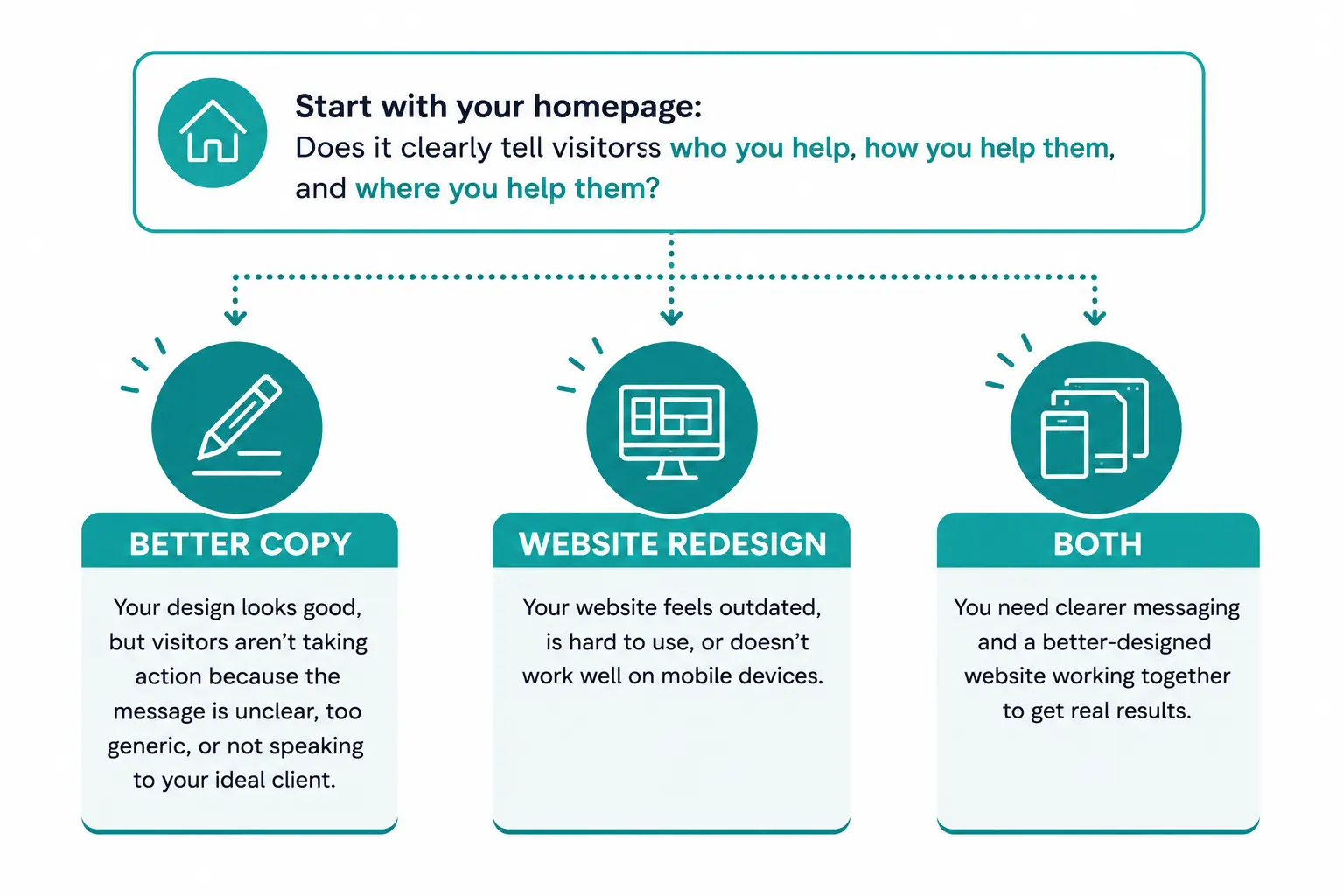
Your website may need better copy when visitors cannot quickly understand who you help, what you offer, and why they should choose you. A redesign may be the better choice when the site feels outdated, performs poorly on mobile devices, lacks clear calls to action, or makes important information difficult to find.
Many service-based business websites benefit from both. Copy communicates the value of the business, while design organizes that message and guides visitors toward the next step.
A quick place to start is the first section of your homepage. Does it clearly explain who you serve, how you help them, and where you provide your services? If the answer is unclear, your website likely has a copy problem. If the site is difficult to use, slow, outdated, or missing buttons throughout the page, the design also deserves attention.
| What You Are Experiencing | What Your Website May Need |
|---|---|
| People visit the website, but very few book a call or contact you. | Stronger copy, clearer calls to action, and possible layout improvements. |
| The website looks dated or performs poorly on phones and tablets. | A website redesign. |
| The website looks polished, but visitors still seem confused about your services. | Clearer, more specific website copy. |
| Important information appears far down the page or feels difficult to find. | A redesign focused on content organization and user experience. |
| Your website receives very little traffic from Google. | An SEO strategy, followed by an evaluation of the copy and design. |
| The website breaks, cannot be updated, or relies on outdated custom coding. | A redesign on a stable, maintainable platform. |
 Most Business Owners Know When Their Website Has a Problem
Business owners are usually good at recognizing when their website has stopped working for them.
They may feel embarrassed to send people to it. Leads may have slowed down. Visitors may land on the site and leave without making contact. The business may have changed while the website stayed frozen in time.
The difficult part is identifying the cause.
A lack of leads can come from several places. The site may have unclear messaging. The layout may make information difficult to find. The website may receive very little traffic. It may also create technical frustrations for visitors using mobile devices.
Each problem requires a different solution.
After more than a decade of designing websites and writing copy for service-based businesses, I have found that most people who approach me for a redesign genuinely need one. Their sites often look outdated, no longer function correctly, or fail to meet current mobile standards.
Every once in a while, though, I review a website that still looks fresh and professional. The layout works. The pages function correctly. The real issue lives in the words.
In those situations, changing the copy can create a dramatic difference without rebuilding the entire website.
When Your Website Needs Better Copy
Your website copy has one major job: help the right person understand that they are in the right place.
That understanding should happen quickly.
When someone lands on your homepage, they should immediately know:
- Who you help
- What you help them accomplish or solve
- What service you provide
- Where you provide it, when location matters
- What they should do next
A headline such as “Welcome to Our Company” uses the most valuable space on the website without communicating anything meaningful to the visitor.
Your visitor already knows they reached your company’s website. They need to know whether you can help them.
Signs Your Website Copy Needs Work
Your copy may be limiting conversions when:
- Your homepage headline focuses on your company name instead of your customer’s needs.
- Your services sound vague or interchangeable with competitors.
- Your pages use industry terminology that clients rarely use themselves.
- Your writing assumes visitors already understand your process or specialty.
- Your calls to action feel generic or appear only once on the page.
- Your content contains long explanations without clear headings.
- Every page sounds like it could belong to any company in your industry.
- Your website relies heavily on generic AI-generated content.
Clear website copy should sound like the language your ideal client uses when describing their problem.
You may understand your service at an expert level. Your potential client probably does not. They need you to break the information down in a way that feels approachable, useful, and easy to understand.
My son sometimes tells me that he has to explain things to me as though I am a toddler. He is learning subjects at a level far beyond my own knowledge, so he has to translate them into language that makes sense to me.
Business owners need to do the same thing for their clients.
Your expertise builds authority. Your ability to explain that expertise clearly builds trust.
One Copy Rewrite Led to a Booked Call Within 12 Hours
One of my favorite examples came from a business owner whose website had been filled with copy taken directly from ChatGPT.
The pages included emojis on nearly every line. The homepage, about page, and service pages all sounded like generic first-draft AI content. She had asked for website copy, received a response, and pasted it onto the site.
The design remained exactly as it was.
I did not move the buttons. I did not change the page layout. I did not rebuild the website or adjust the visual design.
I supplied new copy that clearly communicated what she offered, who she helped, and why someone should work with her.
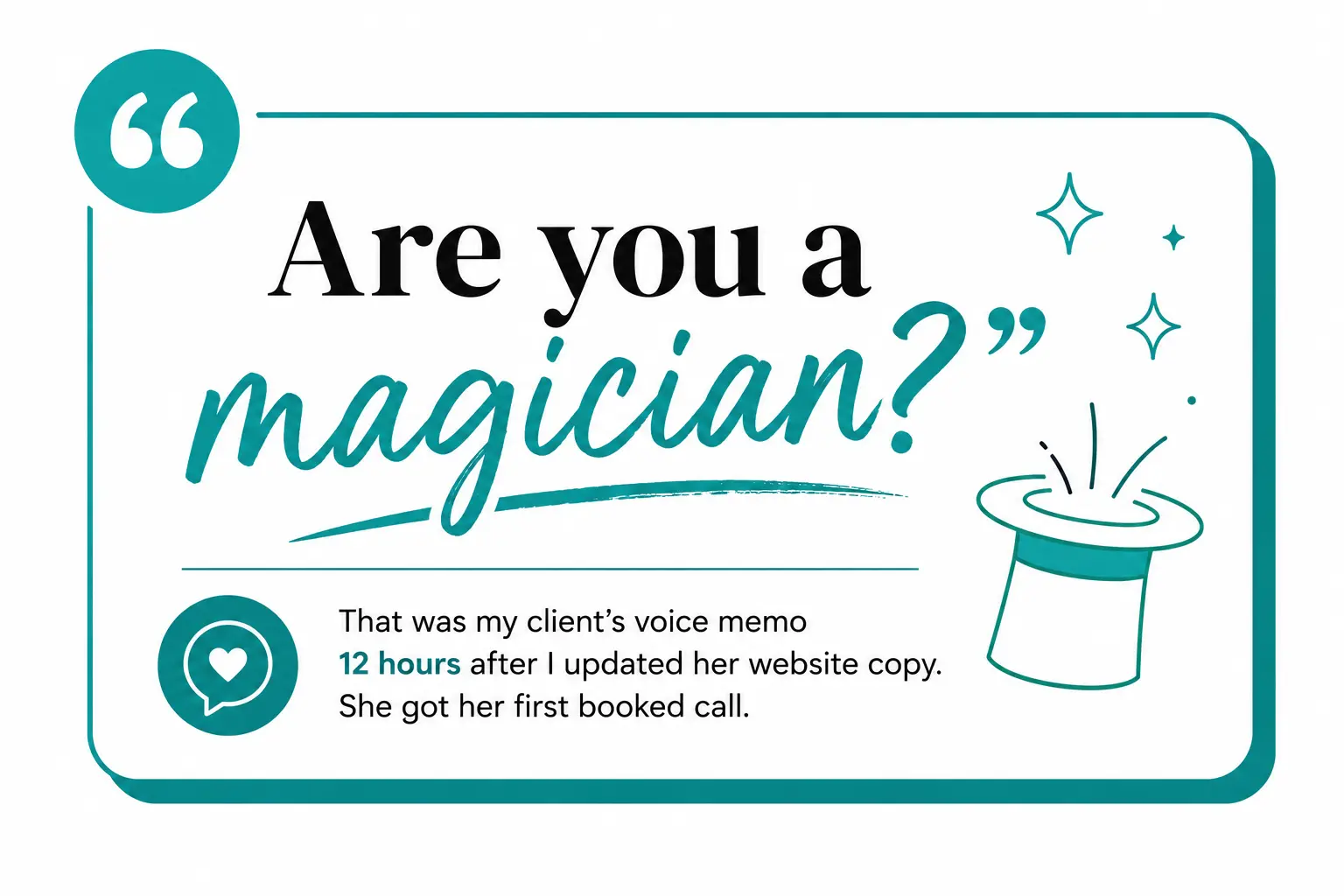
Within 12 hours of adding the new copy, she sent me a voice memo asking if I was a “fucking magician.”
She had received her first directly booked call.
Before that change, people occasionally submitted the contact form to ask a question. No one had taken the step of booking a call.
That result came from the words alone.
The story also highlights an important point about AI. AI can support the copywriting process when it receives the right information and direction. Generic prompts tend to produce generic content.
Your website needs your experience, customer insight, opinions, process, examples, and personality. AI cannot include those elements unless you provide them.
I explore a similar issue in Can ChatGPT Do an SEO Audit?. AI can be a useful tool, but its output still requires strategy, context, and experienced review.
 When Your Website Needs a Redesign
A redesign becomes necessary when the website’s structure, technology, or user experience prevents the content from doing its job.
Great copy needs a clear place to live.
Visitors need headings that help them scan the page, sections that follow a logical order, and buttons that appear when they are ready to make a decision.
The Website Does Not Work Well on Mobile Devices
A website that requires pinching, zooming, or sideways scrolling creates immediate friction.
Mobile visitors should be able to read the content, click buttons, open menus, and complete forms comfortably. When the site cannot provide that experience, a redesign is usually the most practical solution.
Mobile usability also affects conversions. A visitor who struggles to navigate the site has fewer reasons to stay, explore, and contact the business.
For a closer look at this issue, read How Mobile-First Design Improves Website Conversions.
The Design Looks Visibly Outdated
Some design choices instantly date a website.
Examples include bright colors covering the entire page background, small text, narrow content columns, outdated image effects, crowded sidebars, and page layouts created for desktop screens alone.
An older visual style can also affect trust. Visitors may wonder whether the business still operates, whether the information remains current, or whether the company can provide the level of service they expect.
A fresh design gives the business an opportunity to present its current services, expertise, team, and brand more accurately.
The Website Is Difficult to Update or Keep Secure
Some older websites rely on extensive custom coding, abandoned plugins, or outdated themes.
Over time, the business may become unable to update the site safely. Sections stop functioning. Forms break. Security updates create conflicts. Even simple content changes become expensive or time-consuming.
I recently spoke with a potential client whose website contains so much custom code that routine updates are no longer possible. The site has begun to lose functionality, and keeping it secure has become increasingly difficult.
In cases like that, new copy alone would leave the larger technical problem in place.
A redesign provides a stable foundation the business can maintain over time.
The Layout Hides Important Information
Some websites place a large photograph or decorative section at the top of a service page, forcing visitors to scroll before they learn what the page offers.
Other sites bury essential information under company history, lengthy introductions, or visual elements that add little value.
Your most important information should appear early.
Service pages should clearly introduce the service, explain who it helps, and guide the visitor toward the next step. Decorative elements can support the message, but they should never delay it.
The Website Lacks Calls to Action
Many websites include one button in the navigation menu and another at the very bottom of the page.
That leaves a large gap between opportunities to convert.
Calls to action should appear throughout the page at natural decision points. After learning about the service, reading a benefit, viewing a testimonial, or understanding the process, a visitor may feel ready to act.
A nearby button makes that action easy.
The Content Has No Clear Organization
I once began a project expecting to make a few layout edits. Within an hour of reviewing the site, I realized the client needed a complete redesign.
Every page contained an overwhelming amount of text. Information about the owner appeared across multiple pages. Lists of the clients she served appeared repeatedly. Service details, biography content, and duplicate explanations had been mixed together throughout the website.
A visitor could land on a page and struggle to identify its purpose.
The sentences themselves were only part of the issue. The entire content structure needed to be reorganized.
We moved forward with a complete redesign so each page could have a clear purpose, relevant content, and a logical path toward conversion.
How Design Can Weaken Strong Copy
Copy and design work as a team.
A strong headline loses power when it sits below a large image that fills the screen. A compelling service explanation becomes difficult to absorb when it appears as one enormous wall of text. A persuasive page may still lose leads when the next step remains hidden.
When I review a website, I look for several design and layout issues:
- Important information buried too far down the page
- Large visual sections that delay the main message
- Long paragraphs without useful headings
- Buttons placed far away from decision-making points
- Navigation labels that create confusion
- Pages that combine several unrelated topics
- Heading styles selected for appearance rather than page structure
Visitors rarely read a website word for word from top to bottom. They scan.
Clear headings help them understand the page quickly and find the information that matters most to them. Shorter paragraphs, purposeful sections, lists, and visual breathing room make the content easier to process.
This structure also gives search engines clearer signals about the subject of the page.
Why Flashy Website Design Can Hurt the User Experience
Some business owners assume their website needs more movement, animation, video, and interactive effects to feel impressive.
Those features can create a visually dramatic experience. They can also slow the website down and make common tasks frustrating.
There is a major company in the e-commerce space that millions of people use. Its login screen contains numerous animations and video elements. On my computer, it can take close to two minutes before I can simply log in.
That drives me bonkers.
A login screen has a very simple purpose. The design makes that purpose harder to complete.
The same principle applies to service-based business websites. Visitors want to understand what you offer, decide whether they trust you, and determine what to do next.
Visual elements should support those actions.
Pretty websites can win design awards. Effective websites help businesses generate leads.
Some unattractive websites convert extremely well because the message is clear, the offer is relevant, and the next step is easy to find. A polished appearance can strengthen that experience, but clarity still carries the greatest weight.
When You Probably Need Both Copy and a Redesign
Most of the clients who contact me need improvements in both areas.
Their site may look outdated while also using vague language. It may lack mobile responsiveness and contain weak calls to action. The page layout may feel cluttered, while the content fails to explain what makes the business different.
A combined website and copy project allows every element to work together.
The copy can be written with the final layout in mind. The design can create space for the most persuasive information. Calls to action can appear at the right moments. SEO headings can support both readability and search visibility.
The result becomes a complete marketing tool rather than a collection of pages.
This is the approach I use through my website design services for service-based businesses. The website strategy, copy, design, user experience, and SEO foundation are developed together so the finished site can attract visitors and help turn them into leads.
Check Your Traffic Before Blaming the Website
Conversions can only happen when people reach the site.
Before deciding that your copy or design has failed, review your website traffic in Google Search Console or Google Analytics.
Google Search Console can show whether your website appears in search results and whether people click through to your pages.
From there, consider two different scenarios.
Your Website Receives Traffic but Produces Few Leads
This usually points toward a conversion issue.
The copy may be unclear. The page may lack a strong call to action. The design may make the information difficult to follow. Visitors may also reach the wrong page or struggle to understand which service fits their needs.
Review the copy and layout together.
You can also read Why People Visit Your Website and Leave Without Contacting You for a deeper look at the common causes.
Your Website Receives Very Little Traffic
This points toward a visibility issue.
A beautifully written and thoughtfully designed website still needs a way to attract visitors. SEO, content creation, local landing pages, referrals, social media, email marketing, advertising, and direct outreach can all contribute to website traffic.
In this situation, reviewing the site’s SEO foundation should become part of the process.
A Five-Minute Website Self-Assessment
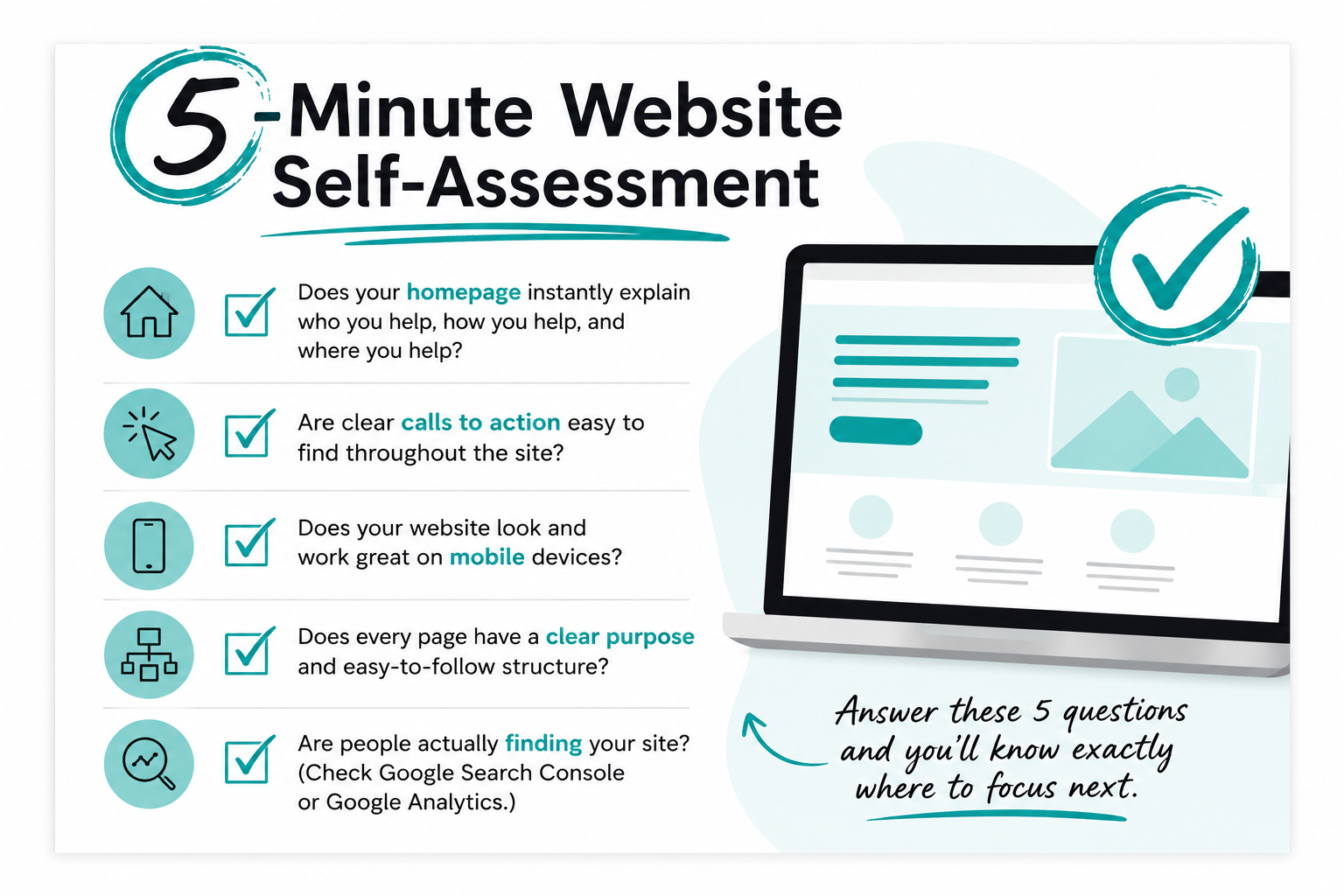
You can learn a great deal about your website by answering the following questions.
1. What Does the First Section of Your Homepage Say?
Look at the website before scrolling.
Can a new visitor identify who you serve, what you provide, how you help, and where you work?
A vague hero section often signals similar copy problems throughout the site.
2. Can Visitors Find a Next Step Throughout the Page?
Scroll through your homepage and service pages.
Look for buttons near the sections where someone may feel ready to contact you, schedule a consultation, request a quote, or learn more.
Several long sections without a call to action can reduce conversions.
3. Does the Site Work Comfortably on Your Phone?
Open the website on a mobile device.
Test the menu, buttons, forms, text, images, and page speed. Pay attention to anything that feels difficult, crowded, slow, or awkward.
4. Can You Explain the Purpose of Every Page?
Each page should have a clear subject and goal.
Your about page should introduce the people and story behind the business. Service pages should focus on individual services. Location pages should support a specific service area. The contact page should make reaching you simple.
Repeated and mixed content often signals a need for stronger site organization.
5. Are People Finding the Website?
Review Google Search Console and Google Analytics.
Traffic data helps separate a visibility problem from a conversion problem. A site receiving traffic and producing few leads requires a different strategy from a site receiving almost no visitors.
Website Copy Has Changed in the Age of AI
Years ago, many business owners struggled to write enough content.
They had years of knowledge and experience in their heads, but translating it onto a page felt difficult. Their websites contained a few sentences, broad service descriptions, and very little explanation.
Some also wrote at such an advanced level that potential clients could not understand the service.
Today, business owners have the opposite opportunity. AI can create a large amount of content within seconds.
The challenge now is quality and specificity.
AI frequently produces polished sentences filled with familiar marketing phrases. Without detailed prompting, those sentences sound like thousands of other websites.
Useful website copy requires real information:
- How you work
- What you believe
- Who you serve best
- What clients ask you
- What problems you regularly solve
- What you have learned through experience
- What makes your process different
- What results or transformations clients have experienced
That information turns generic content into credible copy.
Choose a Web Designer Who Understands SEO
Before spending thousands of dollars on a redesign, choose someone who understands how websites support search visibility.
Many web designers use heading styles to control appearance. A large heading may be selected because it looks good, while a smaller heading may be selected for a visual effect.
Headings also have a functional purpose.
They organize the page for visitors, support accessibility, and help search engines understand the relationship between topics.
I frequently see important heading tags applied to phrases such as “Connect,” “Tell Me More,” or other generic language with little search value. Meanwhile, the actual service name appears as regular paragraph text.
These choices affect the website long after the visual design has been approved.
A website is a marketing asset. Its design, copy, SEO, performance, and conversion strategy should support the same business goal.
So, Does Your Website Need a Redesign or Better Copy?
Start with your homepage hero section.
Does it immediately explain who you serve, how you help them, and where you provide your services?
A vague or generic opening usually points toward a copy issue.
Next, review how the website functions. Does it work well on mobile devices? Can visitors easily find buttons and next steps? Is the information organized clearly? Can the website be updated and kept secure?
Problems in those areas point toward a redesign.
Then review your traffic. A website with steady traffic and few inquiries usually needs stronger conversion-focused copy, layout improvements, or both. A website with very little traffic needs an SEO and visibility strategy as part of the solution.
Your website does not need to be flashy. It needs to be clear, useful, trustworthy, and easy to navigate.
When the words and design support each other, visitors can quickly understand what you do and confidently take the next step.