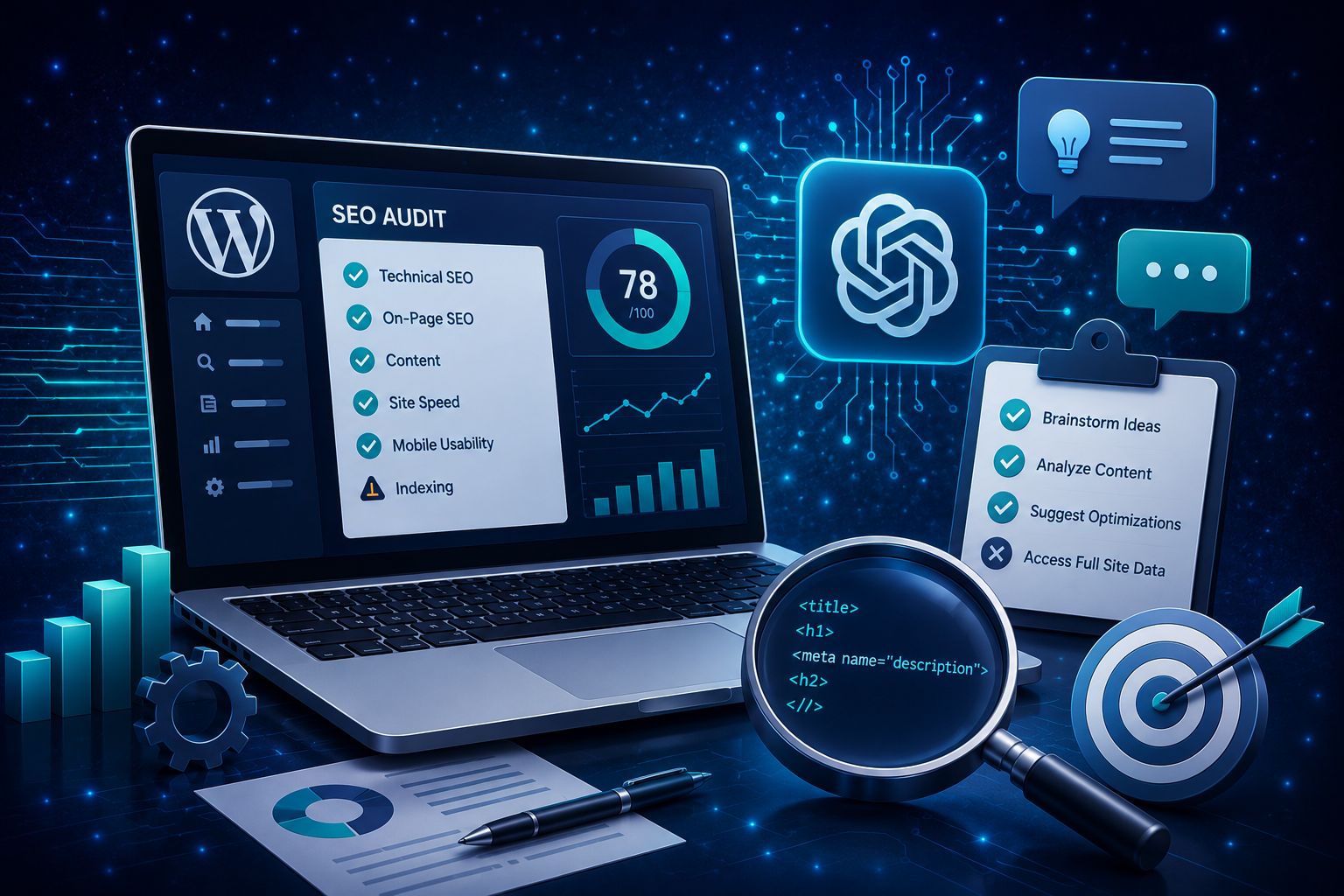
If you’ve spent more than five minutes on the internet lately, you’ve probably seen somebody claiming that ChatGPT can fully audit your website, fix your SEO, rewrite your content, build your strategy, and somehow magically make Google fall in love with your business overnight.
As somebody who has been building websites for over a decade, I need to say this very clearly:
Yes, ChatGPT can help with SEO audits.
No, it should not be your SEO auditor.
Those are two very different things.
Ironically, one of my own systems people recently came to me excited because Claude can now integrate into browsers and “audit” websites. Her thought was that it would make my life dramatically easier.
My response?
“You’re going to have to convince me why that’s a good thing.”
Because here’s the reality: I can usually look at a website within 30 seconds and tell whether the problem is the messaging, the layout and conversion flow, the SEO structure, or all three.
AI is not consistently good at evaluating all of those layers simultaneously the way an experienced strategist can.
Could it eventually get there? Maybe.
Do I think it’s there today? Not even close.
What ChatGPT Is Actually Good at During an SEO Audit
I still use ChatGPT in my SEO process constantly.
That surprises people when they hear me say I don’t think it should replace an SEO audit.
The difference is this:
There’s a huge gap between letting AI assist you and letting AI drive the strategy.
ChatGPT Can Help With SEO, But It Shouldn’t Replace the Strategy
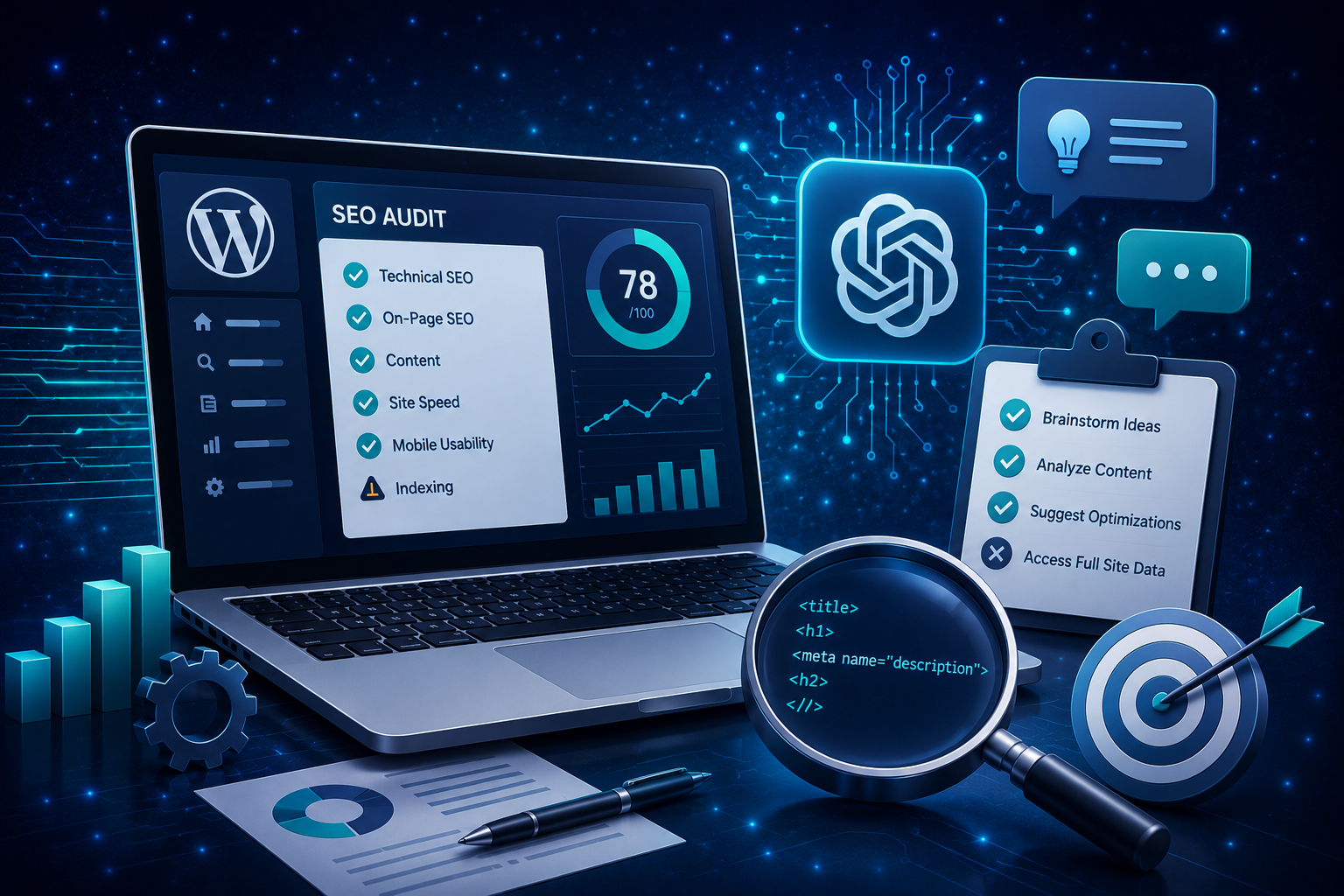
I use ChatGPT to help brainstorm content ideas, organize information, improve readability, summarize competitor content, structure blog posts, generate metadata drafts, refine messaging, and speed up repetitive tasks.
But I do not rely on it to independently determine whether a website is strategically effective.
That requires human judgment.
And honestly? That’s the part most business owners are accidentally outsourcing to AI without realizing it.
Why AI SEO Audits Miss Critical Problems
One of the biggest issues with AI-driven audits is that people assume ChatGPT can “see” a website the same way Google sees a website.
It can’t.
Most people feed ChatGPT a screenshot of the homepage, a URL, or text copied from a page. But that doesn’t necessarily give AI access to the actual code structure of the site.
And structure matters.
A lot.
For example, one of my favorite SEO audit discoveries was a website where literally everything was tagged as an H3.
Every. Single. Thing.
There was no heading hierarchy whatsoever.
Search engines rely on heading structures to understand what the business does, who the business helps, what information matters most, and how the page is organized.
But many designers, especially designers without SEO experience, use heading tags for aesthetics instead of structure.
The result?
A website that might look visually fine to humans while sending complete chaos to search engines.
This is one of the reasons I talk so often about the common SEO mistakes small businesses make. A lot of those mistakes are not obvious on the surface, but they can absolutely affect whether Google understands your website.
A screenshot alone would never fully expose that issue.
That’s why dedicated SEO tools still matter.
I personally use specialized SEO audit tools that analyze heading structures, metadata, alt text, page speed, technical issues, indexing concerns, mobile usability, SEO hierarchy, and crawlability.
ChatGPT can assist in interpreting data.
It is not a replacement for gathering the data correctly in the first place.
SEO Drives Traffic, But the Human Element Closes the Deal
This is where a lot of AI-generated SEO advice completely falls apart.
SEO is not just about pleasing search engines.
It’s also about understanding human behavior.
 I’ve been building websites for over a decade, and over time, patterns become obvious.
For example, if your homepage starts with “Welcome to our website,” we already have a messaging problem.
Your website should immediately tell visitors who you help, how you help them, and why they’re in the right place.
That clarity matters because confused people do not convert.
And no AI audit tool fully understands your audience psychology the way an experienced strategist can.
Sometimes the problem isn’t SEO at all.
Sometimes the website is getting traffic just fine, but the messaging is weak, the calls-to-action are unclear, the layout creates friction, or the audience targeting is too broad.
This is exactly why I wrote about why service-based business websites struggle to get leads. A website can technically exist, technically have content, and technically be online… but still completely miss the human being who needs to understand what to do next.
I frequently see businesses trying to target too many completely different audiences at once.
For example, if a performing arts company offers singing lessons, acting lessons, and piano lessons, that still feels cohesive.
But then suddenly introducing unrelated adult coaching programs into the same messaging can muddy the waters and confuse visitors.
When users become confused, conversions drop.
That’s not just an SEO issue.
That’s a business clarity issue.
Call-to-Actions Matter More Than Most People Realize
One thing AI audits often underemphasize is conversion flow.
A website can technically rank well and still fail as a business tool.
If somebody reaches a decision point while reading your website and thinks, “Yes. This is exactly who I want to hire,” but then they have to hunt around for how to contact you, you’ve created resistance.
Good websites reduce friction.
The goal is to make the next step obvious:
- Book the call.
- Fill out the form.
- Schedule the consultation.
- Make the purchase.
The easier that process feels, the more likely people are to convert.
And while improving calls-to-action may not dramatically boost rankings directly, it absolutely impacts how users behave on your site.
We want people staying on the website longer, clicking deeper into pages, watching videos, reading blogs, exploring services, and actually taking action.
This is also why mobile experience matters so much. If your site is clunky on a phone, hard to navigate, or frustrating to use, people are going to leave before they ever become a lead. I go deeper into that in my post on mobile-first design and conversions.
Where AI Can Actually Become Dangerous
The biggest danger isn’t AI itself.
It’s overconfidence.
People assume ChatGPT can fix everything.
But AI tools are only as useful as the person directing them.
A really strong SEO tool is absolutely worth investing in. But you still have to understand what the data means, which issues actually matter, what should be prioritized first, and what strategy aligns with business goals.
Otherwise you end up chasing random SEO fixes that don’t actually move the business forward.
And honestly? Most small business owners do not have unlimited time.
You’re already serving clients, managing operations, handling emails, running sales, and wearing fifteen other hats.
Trying to become an SEO strategist, technical analyst, content writer, UX specialist, and developer on top of that is a lot.
That’s why many businesses eventually decide it’s more effective to get professional help with SEO for service-based businesses instead of trying to piece everything together from random tools, AI prompts, and conflicting advice.
Real SEO Results Don’t Happen Overnight
This is another area where AI-generated SEO conversations can create unrealistic expectations.
SEO is a long-term strategy.
I regularly tell clients:
Minimum three months.
Minimum.
And even then, the best results often happen six to twelve months into consistent optimization.
 One of my favorite client success stories was a small two-woman therapy practice.
When they hired me, they told me upfront they could only commit to three months of SEO work.
So we focused on technical fixes, blog content, city-specific landing pages, and SEO structure improvements.
At the end of those three months, they told me their inquiry calls had doubled, they were fully booked, and they needed to hire another therapist.
That’s what good SEO strategy can do.
Not because AI magically “audited” a website.
But because there was strategy, clarity, structure, consistency, and human insight behind the decisions.
If you want to better understand what progress actually looks like, I also recommend reading how to measure the success of your SEO efforts, because rankings are only one piece of the puzzle.
So… Can ChatGPT Do an SEO Audit?
Here’s my honest answer:
ChatGPT can absolutely assist with SEO audits.
It can help organize ideas, identify obvious issues, improve workflows, summarize information, and support strategy discussions.
But no, I do not believe it should replace a real SEO audit performed by somebody who understands search engines, human behavior, conversion strategy, messaging, website structure, and business positioning.
Because SEO is never just about rankings.
It’s about building a website that both search engines and humans understand.
And that still requires experience, strategy, and a human touch.