
Most business owners ask the wrong question when it comes to SEO.
They want to know: “Am I on page one?”
That’s not the question. Or at least, it’s not the only one that matters.
After 12+ years and 300+ websites built for service-based businesses, here’s what I’ve learned: SEO success isn’t a single number. It’s a progression. And if you don’t understand the stages, you’ll either panic too early or celebrate too soon.
Let’s break it down.
Start With a Baseline, Not a Wish List
Before you can measure SEO success, you need to know where you’re starting from.
The first thing I do with every SEO client is run a full SEO audit. I’m looking for technical issues that may be quietly preventing the site from ranking, including broken links, slow load times, missing metadata, crawl errors, and other behind-the-scenes problems. If you’re not sure what goes into that process, here’s a breakdown of how to optimize a website for SEO.
Then I look at the heading tags.
What keywords is this site actually trying to rank for? Are those keywords getting real search traffic? Because you’d be surprised how many businesses are “ranking” for terms nobody is actually searching.
I’ve had clients fixate on one keyword that had little to no search volume. We would have conversations month after month about why that keyword wasn’t going to move the needle, but they were convinced it was the only thing that mattered.
That’s not how this works.
Measuring SEO success has to start with the right targets. If you’re chasing vanity metrics or irrelevant keywords, no amount of “progress” will translate into actual business.
The 3-Stage Framework: Impressions, Clicks, and Conversions
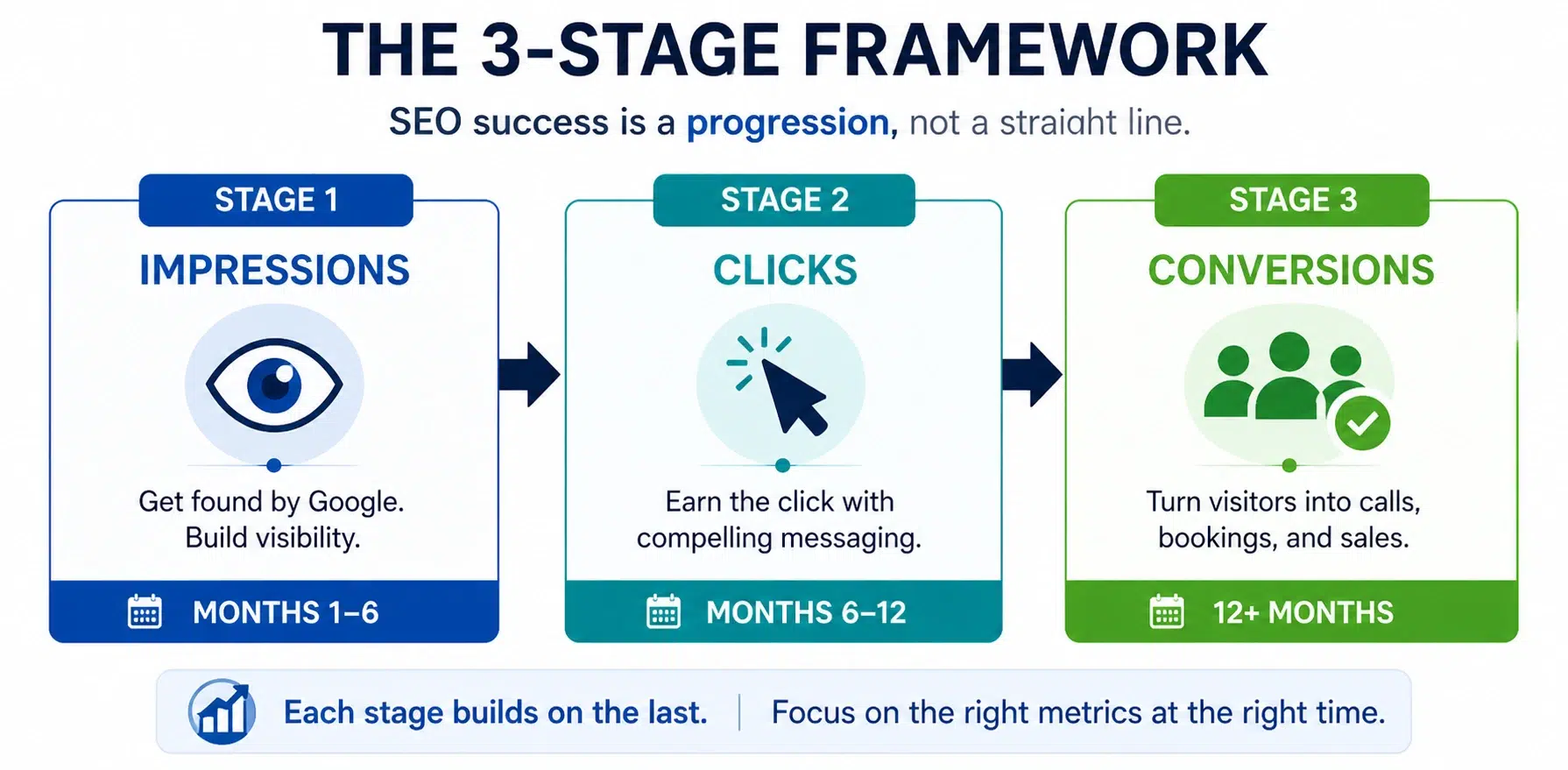
SEO doesn’t work in a straight line. It works in stages. Each stage has its own metrics, and expecting stage-three results in stage one will drive you, and your SEO strategist, absolutely bananas.
Stage 1: Months 1–6, Watch Your Impressions
In the first six months, I’m not obsessing over page-one rankings. I’m watching impressions.
Impressions tell you that Google is noticing your site. When impressions are rising, it means Google is testing you and moving you into different places in the rankings to see how people respond.
That’s a good sign.
That’s momentum.
If impressions are going down, that tells me something is off and we need to look closer at the strategy.
This is also the stage where targeting enough of the right keywords starts to matter. Not one magic keyword. Not one phrase your competitor ranks for. A strategic mix of keywords that collectively help the right people find your business.
Stage 2: Months 6–12, Improve Your Click-Through Rate
Once impressions are consistently growing, the next thing to evaluate is click-through rate, also known as CTR.
Getting your website to show up in search results is one thing. Getting people to actually click is another.
This is where title tags, meta descriptions, and messaging do the heavy lifting.
If your website is showing up in search results but people are not clicking, that is usually a messaging problem. The search result needs to speak clearly to the person searching. If your website isn’t converting once they land, it may be worth understanding why service-based business websites struggle to get leads.
This is where we optimize the language, not just the keyword.
Stage 3: Conversions, Where the Business Actually Happens
This is the stage most business owners want to jump to on day one.
And I get it. Traffic is nice, but bookings, calls, and purchases are what actually matter.
We can measure how many people are coming to your website. We can measure how many people are clicking through from Google. But whether those people call, book, or buy depends heavily on your website messaging.
Messaging is how you weed out the wrong clients and attract the right ones.
If your website speaks directly to your ideal customer, their problem, their hesitation, and what they need to hear before they take action, they are more likely to convert. If it’s generic, they bounce.
You’ll know your SEO is working when your bookings start filling up. When you’re getting more calls than word-of-mouth alone can explain. When the people reaching out are already a better fit because the website helped pre-qualify them.
What Real SEO Success Actually Looks Like
One of my clients did not need to hit page one for one specific keyword to see results.
Within three months of working together, they were fully booked. Their calls had doubled. They were turning away business and actively looking to hire a third employee just to keep up.
That happened because we started targeting enough of the right keywords that the right people were finding them.
Not massive traffic.
Targeted traffic.
That’s the difference between vanity metrics and real SEO success.
Why I Never Guarantee SEO Results
I never guarantee SEO results because I think that is what scammers do.
No one can guarantee what Google is going to do.
I’ve had a client come to me after hiring multiple companies before me. Those companies keyword-stuffed the website. The site had traffic, but it wasn’t converting because the messaging didn’t speak to the right client.
So we shifted the strategy. We removed unnecessary keyword stuffing and used keywords more intentionally so the messaging actually made sense to the people who needed the service.
But during that same period, everyone in his industry saw massive ranking and traffic drops. It wasn’t something we did wrong on his website. The algorithm changed, and the whole industry felt it.
That’s why promises in SEO make me uncomfortable.
We cannot control the algorithm. We cannot control when Google changes the rules. What we can control is the strategy, the technical foundation, the keyword targeting, the messaging, and the consistency of the work.
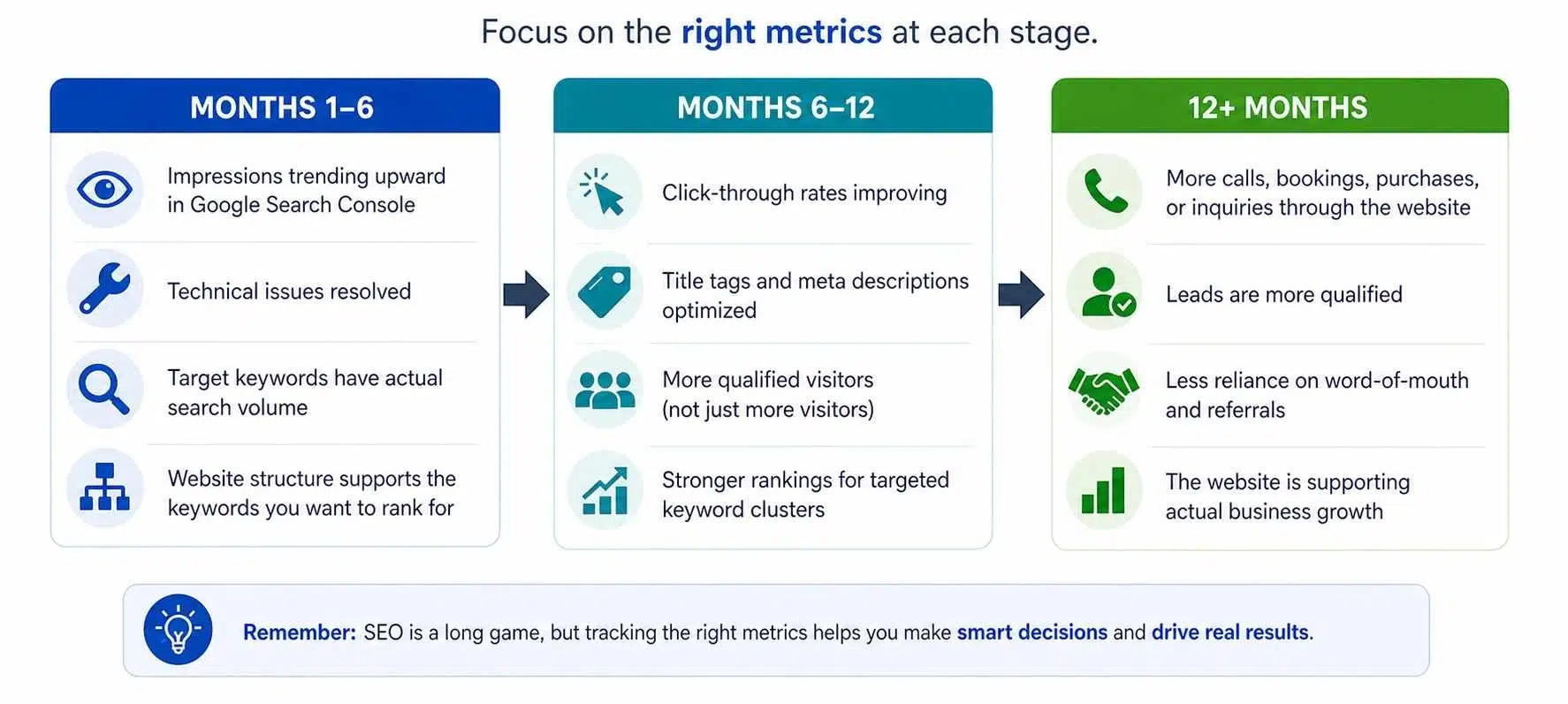
How to Track SEO Progress at Each Stage
 Months 1–6
- Impressions are trending upward in Google Search Console
- Technical SEO issues are being resolved
- Target keywords have actual search volume
- Your website structure supports the keywords you want to rank for
Months 6–12
- Click-through rates are improving
- Title tags and meta descriptions are being optimized
- Visitors are more aligned with your ideal client
- Keyword clusters are gaining traction
12+ Months
- More calls, bookings, purchases, or inquiries are coming through the website
- Leads are becoming more qualified
- The business is less dependent on word-of-mouth alone
- The website is supporting actual business growth
The Uncomfortable Truth About SEO Metrics
Traffic numbers look great in a report. But traffic does not pay your bills.
I’ve seen websites with thousands of monthly visitors and empty appointment books. I’ve also seen websites with a few hundred monthly visitors and fully booked schedules. A lot of that comes down to avoiding common SEO mistakes small businesses make.
The difference is targeted keywords, clear messaging, and a website built to convert.
Not Sure If Your SEO Is Actually Working?
If you want a strategy that actually focuses on impressions, clicks, and conversions instead of vanity metrics, you can learn more about it here: SEO for service-based businesses.
If you’re investing in SEO and you’re not sure what you’re measuring or whether it’s working, that’s a problem worth fixing.
Book your SEO audit today and find out if your website is actually working for your business.