
Most business owners think SEO starts with keywords and blogging. In reality, it starts by fixing the foundation of your website.
That may sound less exciting than a big content strategy or a long list of keywords, but after working on 300+ websites, I can tell you this: the basics are usually where the biggest problems are hiding.
When someone says, “I know I need SEO. Where do I start?” my first answer is usually not, “Start blogging.” It is not, “Install Yoast.” It is not, “Go find 100 keywords.”
My first answer is: look at the structure, messaging, and clarity of the pages you already have.
Start With the Pages You Already Have
Before you add more content to your website, you need to know whether your existing pages are actually doing their job.
A lot of business owners want to jump straight into blogging because they have heard that blogs help with SEO. And yes, blogs can absolutely help. But if your homepage is unclear, your service pages are thin, your headings are used incorrectly, and your copy does not speak to your ideal client, publishing more blogs is not where I would start.
That is like sending more people into a store where nothing is labeled, nobody knows where to go, and the front desk only says, “Welcome to [insert your company name here].”
That does not help anyone.
Headings Are Not for Design. They Are for Function.
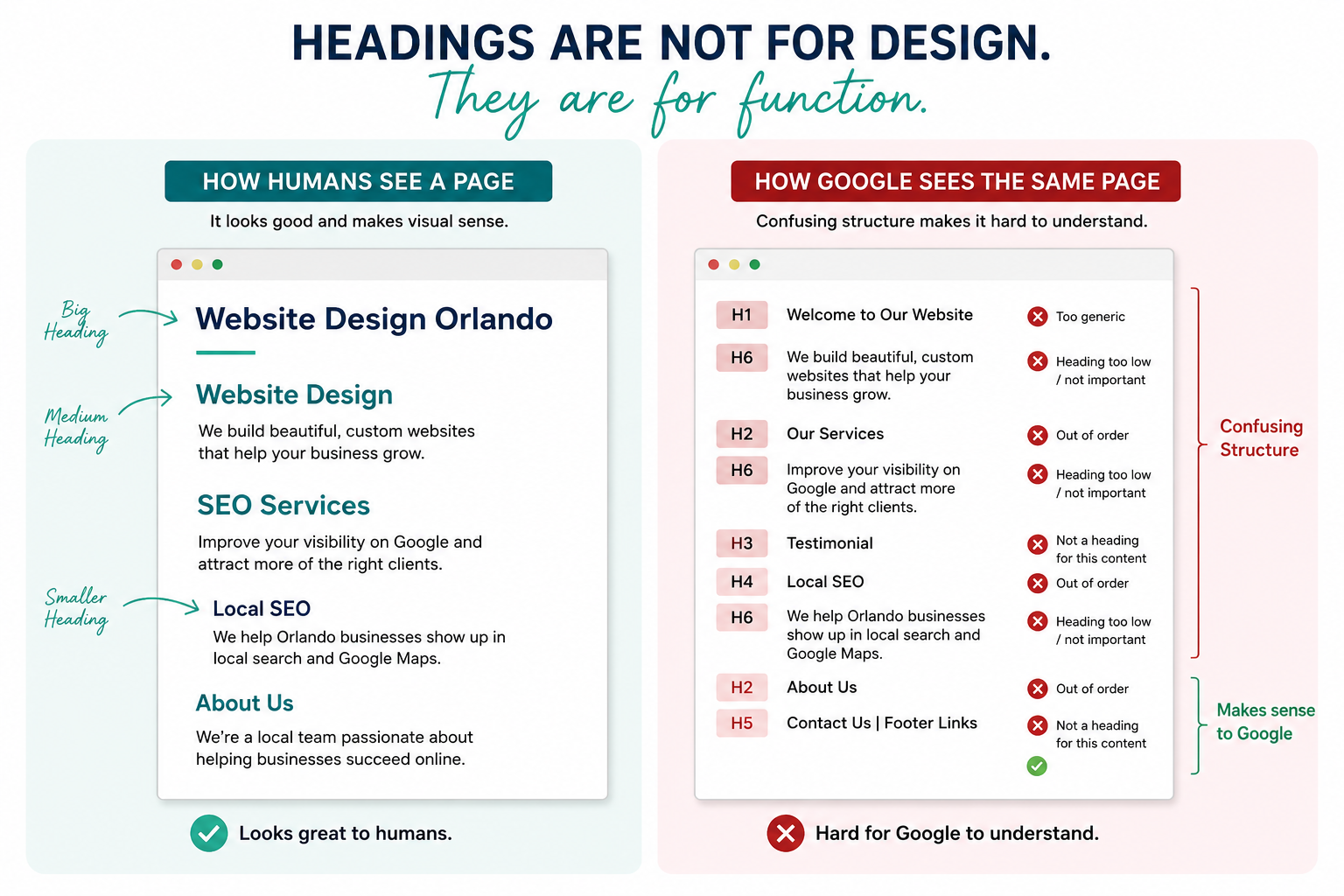
One of the first things I look at on a website is the heading structure.
This comes up constantly.
Many designers, DIY website builders, and even some developers use heading tags because of how they look visually. They choose an H1, H2, H3, or H6 because it gives them the size or style they want on the page.
That is not what headings are for.
Your heading structure is supposed to create the outline of the page. It helps search engines understand what the page is about, what information is most important, and how everything connects.
In general, a page should have:
- One H1 that clearly identifies the main topic of the page
- Multiple H2 headings that organize the main sections
- H3 headings that support or break down the H2 sections
I have seen websites where every single piece of text on the page was set as a heading tag. Paragraphs, testimonials, random blurbs…all headings. I have also seen websites where almost everything was an H6 because someone liked the way it looked.
That creates a mess for SEO.
If Google is trying to understand who you help, what you do, where you serve people, and how the page is organized, your headings need to support that. They cannot just be decorative.
SEO and Messaging Go Hand in Hand
SEO is not only a technical problem. Sometimes the real issue is messaging.
You can bring more traffic to a website, but if the copy does not resonate with the right people, that traffic will not convert.
This is one of the biggest things I see when reviewing service-based business websites. The business owner is often writing from their own perspective instead of the customer’s perspective.
They explain what they do in a way that makes sense to them because they are the expert. But their ideal client does not always use the same language. Their ideal client is usually searching based on a problem, a need, a location, or a specific service.
If your website copy does not reflect that, SEO becomes harder than it needs to be.
That is why I often end up rewriting service page copy inside SEO projects. Technically, I may be working on SEO, but the page cannot perform well if the message is unclear. I do not want to rank a weak page. I want to build pages that deserve more traffic.
SEO Is Not About Getting More Traffic
SEO is not about getting more traffic. It is about building pages that deserve more traffic.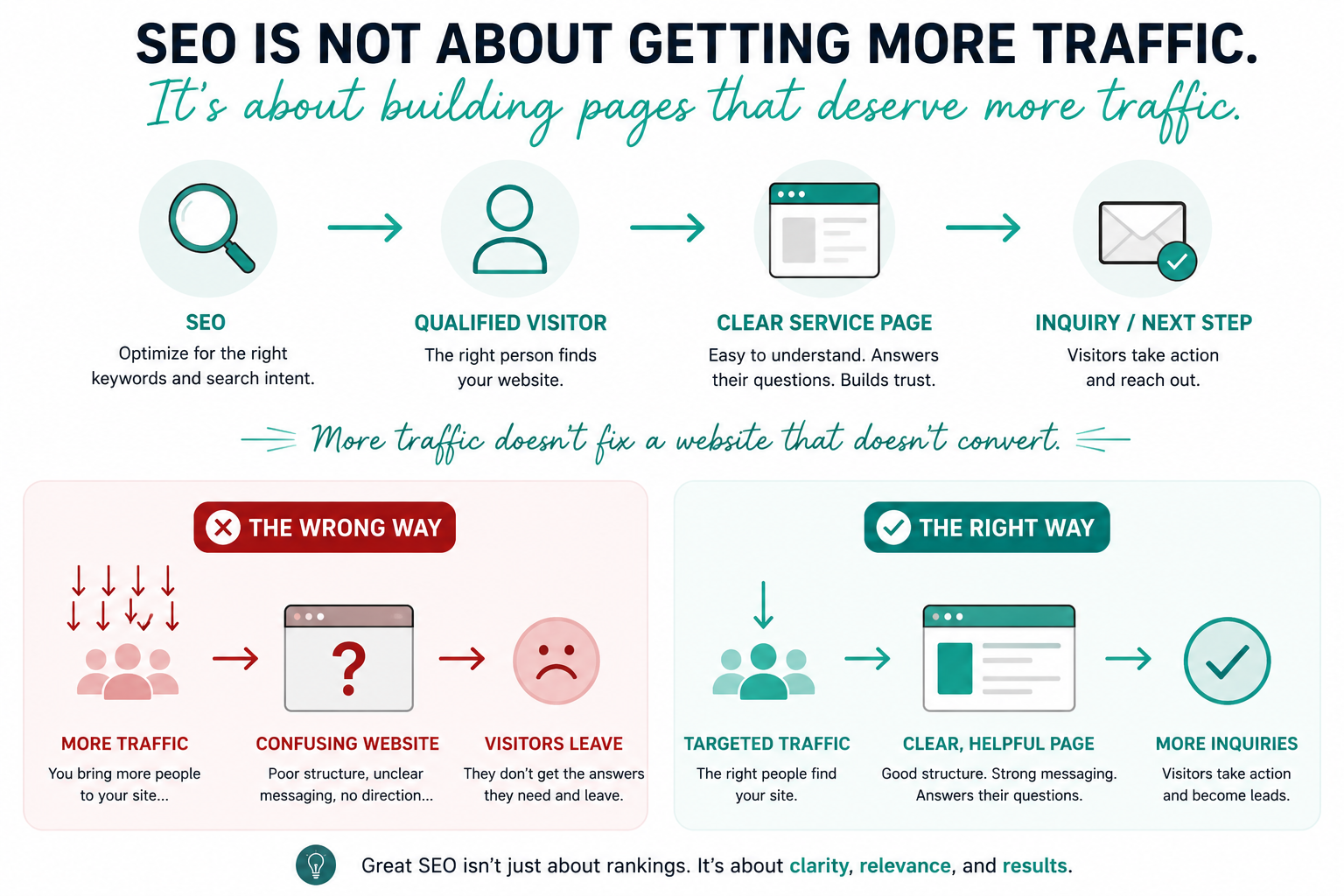
That distinction matters.
If your website is confusing, ranking higher will not magically fix it. It may just mean more people land on a page that does not answer their questions or give them a clear next step.
Before you invest in a long-term SEO strategy, your website needs to answer the basics quickly:
- Who do you help?
- Where do you help them?
- What problem do you solve?
- What service are you offering?
- What should someone do next?
If the first thing on your homepage is something generic like “Welcome to Company XYZ,” that is a problem.
Your homepage should immediately tell people what you do and who you do it for. If you are a local or service-area business, it should also make your location clear.
Every Service You Want to Rank For Needs Its Own Page
Another common problem is trying to make one general “Services” page rank for everything.
If you offer multiple services, each important service should have its own dedicated page. That page should have its own SEO title, meta description, headings, copy, internal links, and clear call to action.
For example, a company that offers website design, SEO, and maintenance should not expect one general services page to rank strongly for all three. Each service needs space to explain:
- What the service is
- Who it is for
- What problems it solves
- What is included
- Why someone should choose you
- What the next step is
This is especially important for service-based businesses because people are usually searching with specific intent. They are not just looking for “services.” They are looking for the specific thing they need help with.
This is also why I recommend starting with your core service pages before building a bigger blogging strategy. If the service pages are weak, the foundation is weak.
Do Not Let SEO Plugins Fool You
Plugins like Yoast and Rank Math can be helpful, but they are not a complete SEO strategy.
One of the biggest misconceptions I see is business owners trying to get all the little green check marks without knowing whether the keyword they entered actually makes sense.
A green light does not mean you picked the right keyword. It does not mean the page matches search intent. It does not mean your website will rank. It means you satisfied that plugin’s checklist.
That checklist can be useful, but only when it is paired with actual strategy.
You need to know what people are searching for, how they are asking for it, and what type of page Google is already rewarding for that search.
Picking random words from your page and setting them as your focus keyword is not SEO strategy. It is guessing.
Your SEO Competitors May Not Be Who You Think They Are
When most business owners think about competitors, they think about the business down the street.
But your SEO competitors are not always your local competitors or industry peers. Your SEO competitors are the websites currently showing up for the searches you want to rank for.
That distinction is important.
If you want to rank for a specific service in a specific location, you need to look at who is already ranking there. What pages are showing up? What topics do they cover? How are their pages structured? What questions are they answering that you are not?
This kind of competitor research can reveal what your website is missing and where your biggest opportunities are.
Small SEO Fixes Can Create Real Results
I have seen small foundational changes make a noticeable difference.
For one client, I did not rebuild her website. I simply rewrote the copy for her existing pages so it spoke more clearly to her ideal client. She added the updated copy herself, without a major redesign or conversion strategy overhaul.
Within 12 hours, she received her first scheduled call through the website. Not just a vague inquiry. A legitimate scheduled call.
For another client, we changed a page URL so it was more specific to the service being offered. Within a few days, she received her first inquiry through the website for that service.
That is not always how SEO works, and I would never promise instant results. But it does show how much the fundamentals matter.
Sometimes the problem is not that you need to publish 20 new blog posts. Sometimes the problem is that your existing pages are not clear, specific, or structured correctly.
So Where Should You Start With SEO?
If you know you need SEO but feel overwhelmed, start with the pages that matter most.
That usually means your homepage and your main service pages.
Before you invest in a full content strategy, review those pages and ask:
- Does this page have one clear H1?
- Are the H2 and H3 headings organized logically?
- Does the page clearly explain who we help?
- Does it explain what service we offer?
- Does it mention the location or service area when relevant?
- Is the copy written in the language our ideal client would use?
- Is there a clear call to action?
- Does each major service have its own page?
- Do the page title and meta description include the right keyword focus?
If the answer to those questions is no, that is where I would start.
When Blogging Does Make Sense
Blogging can be a powerful part of SEO, but it should build on a solid foundation.
Once your core pages are clear, structured, and optimized, blog content can help you answer more specific questions, support your service pages, and show up for searches earlier in the decision-making process.
For example, someone may not be ready to search for an SEO provider yet. They may be asking questions like:
- How do I know if my SEO is working?
- Why is my website ranking but not getting leads?
- Do I need SEO if most of my business comes from referrals?
- Why are people visiting my website and leaving?
Those are great blog topics because they connect to real questions your audience is already asking.
But again, those blogs should support your larger SEO strategy. They should not be random posts created just to check a box.
If you want a deeper look at tracking whether SEO is actually working, you can read How Do I Know If My SEO Is Working?. If your bigger concern is that your website feels outdated or ineffective, I’m Embarrassed to Send People to My Website. Now What? is a good next read. And if you are wondering whether the website itself is the issue, read Why Service-Based Business Websites Struggle to Get Leads.
The Best Place to Start Is the Foundation
If you are asking, “I know I need SEO. Where do I start?” my answer is simple:
Start with the foundation.
Look at your heading structure. Review your homepage message. Check your service pages. Make sure every important service has its own page. Confirm that your titles and descriptions are targeting keywords people actually search for.
SEO is not just about adding more content. It is about making sure your website is clear, structured, useful, and built around the way your ideal clients search for help.
If you are a service-based business owner and you want help figuring out where your SEO should start, learn more about my SEO services for service-based businesses.