
If you’ve been putting effort into SEO and wondering, “Is any of this actually working?” you are not alone.
SEO can feel confusing because the results are not always immediate. You might publish a blog post, update a service page, install an SEO plugin, or tweak your titles and descriptions, then sit there waiting for Google to magically send people your way.
And when that does not happen right away, it is easy to assume something is wrong.
But SEO is a long-term strategy. It takes time, consistency, and the right kind of tracking to know whether your efforts are actually moving in the right direction. The goal is not just to rank. The goal is to bring more of the right people to your website and help turn those visitors into actual leads, calls, bookings, or sales.
So, how do you know if your SEO is working? You look at the right signals.
SEO Takes Time, So Do Not Judge It Too Early
One of the biggest misconceptions about SEO is that it should work immediately.
I have had business owners come to me wanting a new website and expecting to show up on the first page of Google right after launch. I have also had people want a one-page website and expect that single page to outrank established competitors.
That is not realistic.
SEO is a consistency game. It is not something you do once, walk away from, and expect to carry your business forever.
In most cases, I like to give SEO at least three months of specific, targeted effort before making any major judgment calls. That means researched keywords, strategic content, optimized pages, and regular tracking. After that three-month window, you can start comparing your current data to the previous three months and look for movement.
The key word there is movement.
You are not always looking for a dramatic traffic spike. You are looking for signs that Google is beginning to understand your website, show it to more people, and connect it with the right searches.
Start by Asking Whether You Are Actually Doing SEO
Before you decide whether your SEO is working, you need to ask an important question:
What are you actually doing for SEO?
A lot of business owners say they are “doing SEO,” but what they mean is they installed Yoast, Rank Math, or another SEO plugin and tried to get a green checkmark.
That can be helpful as a spot check, but it is not a full SEO strategy.
A green checkmark is not a ranking.
You can perfectly optimize a page for a keyword nobody searches for. You can write a blog post around a phrase you made up in your own head. You can chase plugin recommendations that may not fully reflect what your page, audience, or competitors actually require.
This is one of the most common SEO mistakes small businesses make: they focus on the appearance of optimization instead of building a strategy around real search behavior.
Good SEO starts with research. You need to know what people are searching, how competitive those keywords are, and whether those searches connect to the services you actually want to sell.
The Three SEO Metrics I Look at First
When I want to know if SEO is moving in the right direction, I usually start with three things:
| SEO Metric | What It Tells Me |
|---|---|
| Keyword Rankings | Whether Google is gaining confidence in the content and moving your pages closer to visibility. |
| Impressions | Whether more people are seeing your website show up in Google search results. |
| Click-Through Rate | Whether your SEO titles and descriptions are compelling enough to earn the click. |
| Leads & Phone Calls | Whether your SEO efforts are helping your business grow in a measurable way. |
Keyword rankings help show whether your strategy is gaining traction. If the keywords you are targeting are moving up, that is a positive sign.
Impressions show whether your website is being displayed more often in Google. More impressions usually mean Google is starting to connect your website with more searches.
Click-through rate tells you whether people are choosing your website once they see it. If impressions are increasing but clicks are not, your titles and descriptions may need to be adjusted so they better match what people are looking for.
This is why SEO measurement is more layered than “Did I get a lead this week?” Leads matter. Absolutely. But before the lead happens, your website has to be found, shown, clicked, and trusted.
Use Google Search Console and Google Analytics to Track SEO Progress
If you do not have Google Search Console and Google Analytics set up, you are basically guessing.
Google Analytics helps you understand what people do once they land on your website. You can see whether traffic is increasing, what pages people visit, and how users move through your site.
Google Search Console gives you more specific SEO data. It shows what search queries people use to find your website, how many impressions your pages are getting, how often people click, and where your average rankings are trending.
Both tools matter because they help you separate feelings from facts.
Without data, it is easy to say, “I do not think my SEO is working.” With data, you can ask better questions:
- Are more people seeing my website in search results?
- Are my target keywords improving?
- Are people clicking when they see my website?
- Are visitors taking action once they land on the site?
That last question is important because SEO and website conversion work together.
SEO Traffic and Website Conversions Are Two Different Problems
Sometimes SEO is doing its job, but the website still is not bringing in leads.
You might have more impressions. You might have better rankings. You might even have more clicks.
But if those visitors are not calling, booking, filling out your form, or taking the next step, then the issue may be conversion.
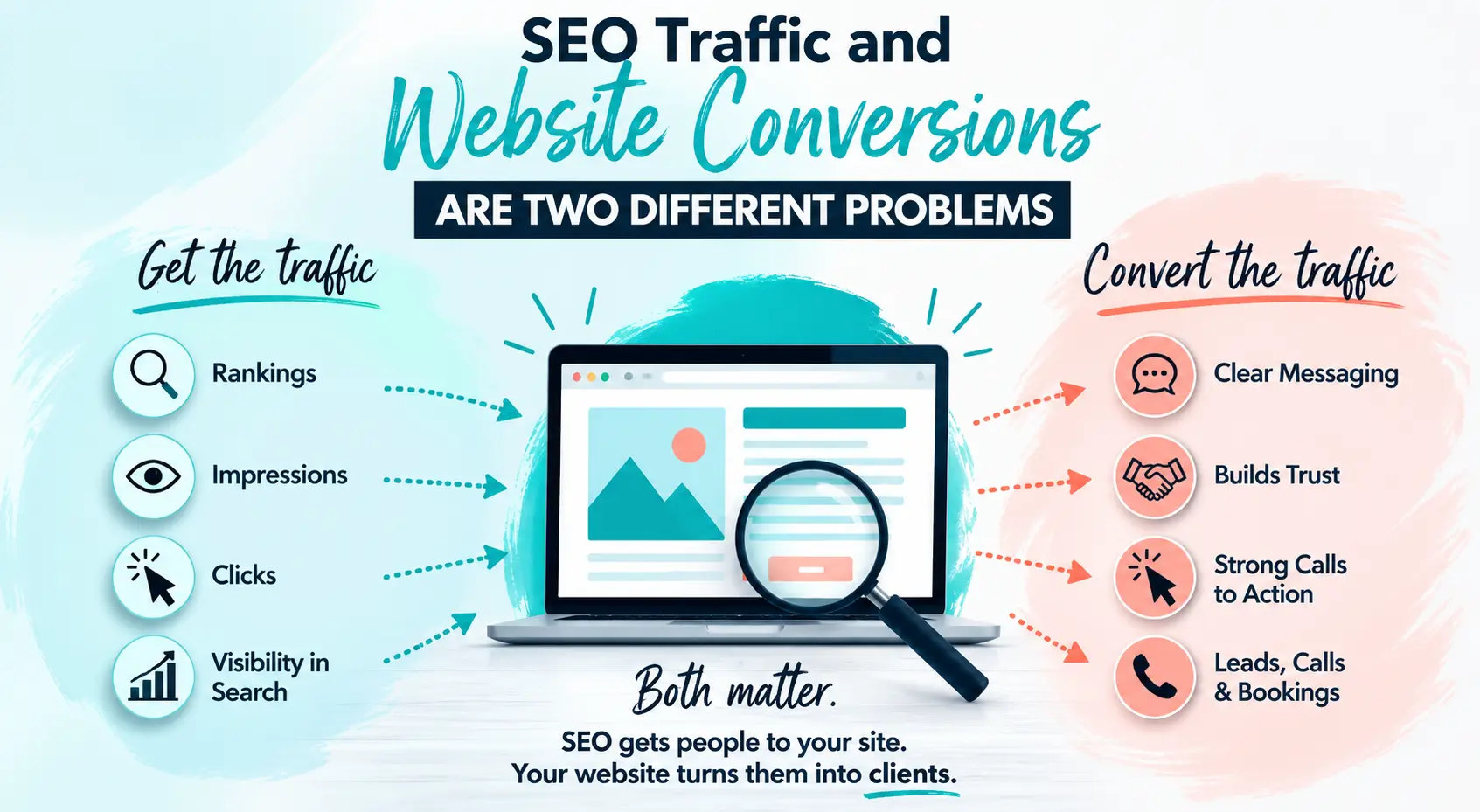 This is where a lot of business owners get stuck. They assume the problem is traffic when the real issue may be the website message, the offer, the layout, the calls to action, or the overall user experience.
Think of it like this:
| If This Is Happening | You May Have This Problem | What to Work On |
|---|---|---|
| Low impressions, low rankings, low traffic | SEO visibility problem | Keyword strategy, content, service pages, technical SEO |
| Higher impressions but low clicks | Search result messaging problem | SEO titles, meta descriptions, page relevance |
| Traffic is coming in but leads are not increasing | Conversion problem | Website copy, calls to action, page layout, offer clarity |
SEO gets people to the website. Your website has to help them understand why you are the right choice.
That is why your SEO strategy and your website strategy cannot be completely disconnected. If you want the full picture, you need to look at both traffic and conversions.
If you are unsure which side of the problem you are dealing with, start by reviewing how to measure the success of your SEO efforts so you know which numbers are worth watching.
Small SEO Improvements Can Create Big Business Results
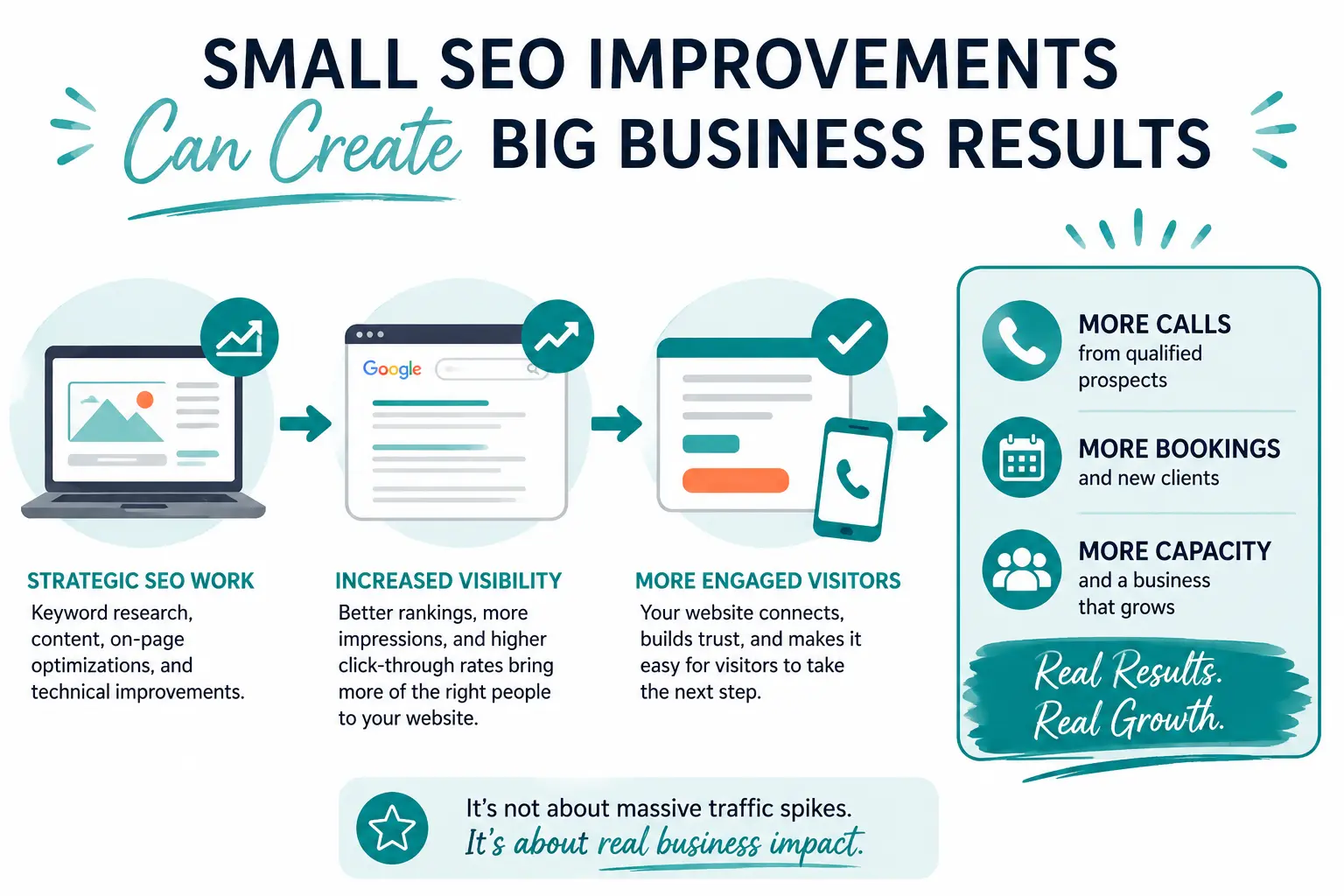 One of my favorite SEO examples came from a client where the analytics did not look wildly impressive at first.
We worked on their SEO for three months. When I looked at the data, there was a little bump in traffic, but nothing that looked dramatic on a report.
Then we had our quarterly review call.
The client told me their phone calls had doubled. They were at max capacity for taking on new clients. They were even looking to hire another therapist because so many people were reaching out to the practice.
That is the kind of SEO result that matters.
A massive traffic spike looks exciting on social media, but a small increase in the right traffic can make a major difference for a small business. If the people finding your website are the people who need your services, you may not need thousands of extra visitors to see a real business impact.
When SEO Is Working, Look for Directional Movement
When I evaluate SEO, I am looking for direction.
Are the right keywords moving up?
Are impressions increasing?
Is the click-through rate holding steady or improving?
Are leads, calls, consultations, or bookings increasing?
Those are signs that the strategy is moving in the right direction.
If impressions are going up, Google is showing your website to more people. If rankings are improving, your content is gaining traction. If click-through rate is improving, your titles and descriptions are doing a better job earning attention in search results.
And if calls or form submissions are increasing, that is where SEO starts connecting to actual business growth.
If you want a deeper breakdown of what SEO can realistically do for your business, I cover that more directly in my guide to SEO for service businesses.
When SEO Needs a Strategy Adjustment
After three to four months of focused effort, there should be some kind of useful signal.
That does not always mean a flood of leads. It may show up as keyword movement, more impressions, stronger click-through rates, or clearer search visibility around specific topics.
But if everything is flat after several months of consistent work, it is time to revisit the strategy.
That may mean your keywords are too broad. It may mean the competition is stronger than expected. It may mean your content needs to become more specific. It may mean your website is attracting people but failing to convert them.
This is where you adjust instead of panic.
SEO strategy is not something you set once and never touch again. You use the data to decide what the next round of work should focus on.
Sometimes that means creating more targeted blog posts. Sometimes it means improving service pages. Sometimes it means updating SEO titles and descriptions. Sometimes it means taking a hard look at the website messaging.
And sometimes, yes, it means using better tools or getting a second set of eyes. ChatGPT can help with certain parts of SEO analysis, but it should be used with context, data, and human judgment. I explain that more in this post on whether ChatGPT can do an SEO audit.
SEO Works Best When You Stay Consistent
SEO is not a “do a little this month, disappear for three months, then come back and do one more thing” kind of strategy.
It works best when you commit to regular effort.
That may include updating service pages, writing strategic blog posts, improving titles and descriptions, fixing technical issues, building out location pages, adding internal links, and watching the data over time.
Consistency is where SEO starts to build momentum.
If you are willing to put in the effort, great. If you would rather hire someone so you can stay focused on serving your clients, also great. What matters is that SEO gets treated like a real part of your marketing strategy instead of an occasional task you remember when business gets slow.
So, How Do You Know If Your SEO Is Working?
You know your SEO is working when the right signals start moving in the right direction.
Your rankings improve for researched keywords. Your impressions increase. Your click-through rate improves or gives you useful feedback. Your website starts bringing in more qualified traffic. And eventually, that traffic should connect to real business activity.
More phone calls.
More form submissions.
More consultations.
More bookings.
More of the right people finding you at the right time.
At the end of the day, SEO is a tool to get more business. I would rather hear that your phone is ringing more often and you are booked to capacity than hear about a giant traffic spike that did not generate a single client. SEO works when it helps your business grow, not when it gives you a pretty graph to post on social media.
If you want help figuring out whether your website has an SEO problem, a conversion problem, or a little bit of both, take a look at my SEO services for service-based businesses.